13 - Mesh Shaders: GPU Cluster Culling
Tutorials 1-12 fed the GPU geometry from vertex + index buffers. This one
removes them entirely. VK_EXT_mesh_shader replaces the whole vertex-input
stage with a two-stage, compute-like pipeline that amplifies geometry on the
GPU: a task shader decides what to draw, and a mesh shader generates the
vertices and primitives for it – no vertex buffer, no index buffer, no
draw-call geometry at all.
The headline rails:
No geometry input.
cmd_draw_mesh_tasks_e_x_t(1, 1, 1)dispatches a single task workgroup; everything downstream is GPU-generated. There is no vertex shader, noVkPipelineVertexInputState, and no bound vertex or index buffer.Task shader = cluster cull. One workgroup decides which of
MAX_MESHLETS = 8“meshlets” survive and writes the survivor count + indices into a@task_payloadstruct.EmitMeshTasksEXT(count, 1, 1)then dispatches exactlycountmesh workgroups and carries the payload to them. The cull here is a deterministic stand-in – it drops meshlets 3 and 4 to carve a visible gap in the grid – so the pixel-oracle can prove the task stage actually removed geometry on the GPU.Mesh shader = geometry generation. One workgroup per surviving meshlet reads its meshlet index from the payload (keyed by
gl_WorkGroupID, a workgroup-grid builtin valid in mesh shaders), callsSetMeshOutputsEXT(4, 2)to declare four vertices + two triangles, and emits one colored quad at that meshlet’s grid cell throughgl_MeshVerticesEXT.Payload handoff. The
MeshletPayloadstruct – acountplus a fixedsurvivorsarray – is the task-to-mesh contract, declared@task_payloadin daslang (the shared task/mesh payload storage).
Every line of every shader is daslang, lowered to SPIR-V at compile time by dasSpirv (no glslang).
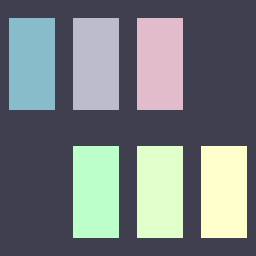
The figure above is the offscreen render: a 2x4 grid where meshlet i sits
at cell (i % 4, i / 4). Meshlets 3 (top-right) and 4 (bottom-left) are
missing – the task shader culled them, and the gap is the GPU-side proof. The
[test] pixel-oracle keys on exactly that: cells 3 and 4 must read the
background colour, every surviving cell must read its meshlet colour. To see it
live on your own GPU, run the windowed viewer (see See it live below).
Note
Mesh shaders require VK_EXT_mesh_shader. The tutorial soft-skips on
devices without it (lavapipe in CI lacks the extension, so the test passes
as skipped) – the figure here is from a mesh-shader-capable GPU.
The shaders
No vertex shader – just task, mesh, and fragment. The task stage culls; the mesh stage amplifies one quad per survivor; the fragment stage outputs the interpolated meshlet colour.
module mesh_tut_shaders public

require vulkan/vulkan_boost public  // Device + DeviceMemory used by the generated bind helpers
require vulkan/spirv_vulkan_shader public
require spirv/spirv_builtins public

let MAX_MESHLETS = 8

// ===== task -> mesh payload =====

//! Surviving-meshlet list handed from the task workgroup to the mesh workgroups it dispatches.
struct MeshletPayload {
    count     : uint            // how many meshlets survived (== the mesh-workgroup dispatch count)
    survivors : uint[8]         // their grid indices, packed [0 .. count)
}
var @task_payload payload : MeshletPayload

// ===== mesh -> fragment varyings =====

var @out @location = 0 mo_color : array<float3>   // per-vertex smooth color

// ===== TASK: cluster cull =====

[vulkan_task_shader(local_size_x=1, name="mesh_tut_task_spv")]
def mesh_tut_task {
    // Deterministic stand-in cull: keep every meshlet except 3 and 4 (a gap in the middle of row 0/1).
    var n = 0u
    for (i in range(MAX_MESHLETS)) {
        if (i != 3 && i != 4) {
            payload.survivors[n] = uint(i)
            n ++
        }
    }
    payload.count = n
    EmitMeshTasksEXT(n, 1u, 1u)         // dispatch `n` mesh workgroups, carry the payload
}

// ===== MESH: one colored quad per surviving meshlet =====

[vulkan_mesh_shader(local_size_x=1, max_vertices=4, max_primitives=2, name="mesh_tut_mesh_spv")]
def mesh_tut_mesh {
    SetMeshOutputsEXT(4u, 2u)
    let mid = payload.survivors[gl_WorkGroupID.x]   // which meshlet this workgroup draws
    let col = float(mid % 4u)
    let row = float(mid / 4u)
    // cell center in NDC: 4 columns across [-1,1], 2 rows down [-1,1]
    let cx = -1.0 + (col + 0.5) * 0.5
    let cy = -1.0 + (row + 0.5) * 1.0
    let hw = 0.18
    let hh = 0.36
    gl_MeshVerticesEXT[0].gl_Position = float4(cx - hw, cy - hh, 0.0, 1.0)
    gl_MeshVerticesEXT[1].gl_Position = float4(cx + hw, cy - hh, 0.0, 1.0)
    gl_MeshVerticesEXT[2].gl_Position = float4(cx + hw, cy + hh, 0.0, 1.0)
    gl_MeshVerticesEXT[3].gl_Position = float4(cx - hw, cy + hh, 0.0, 1.0)
    let color = float3((col + 1.0) / 4.0, (row + 1.0) / 2.0, 0.6)
    mo_color[0] = color
    mo_color[1] = color
    mo_color[2] = color
    mo_color[3] = color
    gl_PrimitiveTriangleIndicesEXT[0] = uint3(0u, 1u, 2u)
    gl_PrimitiveTriangleIndicesEXT[1] = uint3(0u, 2u, 3u)
    gl_MeshPrimitivesEXT[0].gl_PrimitiveID = int(mid)
    gl_MeshPrimitivesEXT[1].gl_PrimitiveID = int(mid)
}

// ===== FRAGMENT =====

var @in @location = 0 fi_color : float3
var @out @location = 0 fo_color : float4

[vulkan_fragment_shader(name="mesh_tut_frag_spv")]
def mesh_tut_frag {
    fo_color = float4(fi_color, 1.0)
}
The render (headless)
render_mesh builds the offscreen colour target and the mesh-shader
pipeline, records a single cmd_draw_mesh_tasks_e_x_t, and reads the result
back through an sRGB intermediate so the readback bytes are gamma-encoded
(matching the windowed view).
def public render_mesh() : array<uint8> {
    if (volkInitialize() != 0) {
        panic("no Vulkan loader")
    }
    var pixels : array<uint8>
    var inscope instance <- create_instance("dasVulkan tutorial 13", make_api_version(1u, 3u, 0u))
    volkLoadInstance(boost_value_to_vk(instance))
    let phys = select_physical_device(instance)
    let gfx = select_graphics_queue_family(phys)
    var inscope device <- create_device_mesh_shader(phys, gfx)
    volkLoadDevice(boost_value_to_vk(device))
    let queue = get_device_queue(device, gfx, 0u)
    let fmt = VkFormat.R8G8B8A8_SRGB   // sRGB: gamma-encode the linear output on write (recording readback + window blit match)

    var inscope target <- build_offscreen_target(device, phys, MESH_W, MESH_H, fmt)
    var inscope render_pass <- create_render_pass_single_color(device, fmt)
    var inscope framebuffer <- create_framebuffer(device, FramebufferCreateInfo(
        renderPass = weak_copy(render_pass),
        pAttachments <- [weak_copy(target.view)],
        width = uint(MESH_W),
        height = uint(MESH_H),
        layers = 1u))

    var inscope task <- create_shader_module(device, mesh_tut_task_spv)
    var inscope mesh <- create_shader_module(device, mesh_tut_mesh_spv)
    var inscope frag <- create_shader_module(device, mesh_tut_frag_spv)
    var inscope layout <- create_pipeline_layout(device)
    var inscope pipeline <- create_mesh_pipeline(device, render_pass, layout, task, mesh, frag, MESH_W, MESH_H)

    let buf_size = uint64(MESH_W * MESH_H * 4)
    var inscope readback <- create_host_buffer(device, phys, buf_size)
    var poolci : CommandPoolCreateInfo
    poolci.queueFamilyIndex = gfx
    var inscope pool <- create_command_pool(device, poolci)

    run_cmd_sync(device, pool, queue) $(cmd) {
        record_render_pass(cmd, render_pass, framebuffer, full_area(MESH_W, MESH_H), clear_color(0.05f, 0.05f, 0.08f, 1.0f)) {
            cmd_bind_pipeline(cmd, pipeline)
            cmd_draw_mesh_tasks_e_x_t(cmd, 1u, 1u, 1u)   // one task workgroup -> cull -> dispatch mesh workgroups
        }
        copy_image_to_buffer(cmd, target.image, readback, MESH_W, MESH_H)
    }
    map_memory_to_array(device, readback.memory, buf_size) $(m) {
        pixels := m
    }
    return <- pixels
}
Self-verifying
The pixel-oracle (the CI regression gate) renders one frame and asserts the
cull happened: cells 3 and 4 show the background colour, while the other six
show their distinct meshlet colours. On a device without VK_EXT_mesh_shader
it skips cleanly.
[test]
def test_mesh_cull(t : T?) {
    if (!mesh_shader_available()) {
        feint("VK_EXT_mesh_shader not advertised by this device; skipping (CI lavapipe may predate 24.1)\n")
        return
    }
    var p <- render_mesh()
    // survivors: meshlet 0 (col0,row0) and meshlet 5 (col1,row1) are lit with their grid color.
    let m0 = px(p, 32, 64)
    let m5 = px(p, 96, 192)
    t |> success(!is_background(m0), "meshlet 0 (survivor) is lit, not background ({m0})")
    t |> success(m0.y > m0.x + 30, "meshlet 0 color is green-dominant per the grid palette ({m0})")
    t |> success(!is_background(m5), "meshlet 5 (survivor) is lit, not background ({m5})")
    t |> success(m5.y > m5.z + 40, "meshlet 5 is brighter green (row 1) than meshlet 0 ({m5})")
    // culled: meshlet 3 (col3,row0) and meshlet 4 (col0,row1) must be background -- the task removed them.
    let m3 = px(p, 224, 64)
    let m4 = px(p, 32, 192)
    t |> success(is_background(m3), "meshlet 3 was culled by the task shader -> background ({m3})")
    t |> success(is_background(m4), "meshlet 4 was culled by the task shader -> background ({m4})")
    delete p
}
See it live
window/show_mesh.das opens a GLFW window with a Vulkan swapchain and runs
the same single cmd_draw_mesh_tasks_e_x_t per frame. The grid is static –
the visual story is the GPU-generated geometry and the culled gap, not motion.
require glfw/glfw_boost
require vulkan
require vulkan/vulkan_boost
require vulkan/vulkan_window
require ../mesh_tut_shaders.das
require daslib/defer

let W = 800
let H = 600

[export]
def main {   // nolint:STYLE038 - flat viewer lifecycle scaffold
    if (volkInitialize() != 0) {
        panic("no vulkan loader")
    }
    glfwInitVulkanLoader(vk_get_instance_proc_addr())   // must precede glfwInit (macOS loader discovery)
    if (glfwInit() == 0) {
        panic("can't init glfw")
    }
    defer() { glfwTerminate() }
    if (glfwVulkanSupported() == 0) {
        panic("glfw reports no vulkan support")
    }
    glfwWindowHint(int(GLFW_CLIENT_API), GLFW_NO_API)
    glfwWindowHint(int(GLFW_RESIZABLE), GLFW_TRUE)
    var window = glfwCreateWindow(W, H, "dasVulkan tutorial 13 - mesh shaders", null, null)
    if (window == null) {
        panic("can't create window")
    }
    defer() { glfwDestroyWindow(window) }

    var ext_count = 0u
    let glfw_exts = glfwGetRequiredInstanceExtensions(unsafe(addr(ext_count)))
    var inst_exts : array<string>
    inst_exts |> reserve(int(ext_count))
    for (i in range(int(ext_count))) {
        unsafe {
            inst_exts |> push(glfw_exts[i])
        }
    }
    var inscope instance <- create_instance("dasVulkan tutorial 13", make_api_version(1u, 3u, 0u), inst_exts)
    volkLoadInstance(boost_value_to_vk(instance))

    var inscope surface <- create_surface(instance, glfwGetNativeWindow(window), glfwGetNativeDisplay())

    let phys = select_physical_device(instance)
    let gfx = select_graphics_queue_family(phys)
    if (!queue_family_supports_present(phys, gfx, surface)) {
        panic("graphics queue family does not support presentation")
    }
    if (!mesh_shader_supported(phys)) {
        panic("this device does not support VK_EXT_mesh_shader (meshShader+taskShader); cannot run tutorial 13")
    }
    // device with the swapchain extension AND the mesh-shader extension + features (general overload)
    var mf : VkPhysicalDeviceMeshShaderFeaturesEXT
    mf.meshShader = 1u
    mf.taskShader = 1u
    var inscope device <- create_device(phys, gfx, ["VK_KHR_swapchain", "VK_EXT_mesh_shader"], mf)
    volkLoadDevice(boost_value_to_vk(device))
    let queue = get_device_queue(device, gfx, 0u)

    var inscope swap <- create_swapchain(device, phys, surface, W, H)
    var inscope render_pass <- create_render_pass_single_color(device, swap.format, VkImageLayout.PRESENT_SRC_KHR)
    build_swapchain_framebuffers(device, swap, render_pass)

    // task / mesh / fragment SPIR-V emitted by dasSpirv from mesh_tut_shaders.das
    var inscope task <- create_shader_module(device, mesh_tut_task_spv)
    var inscope mesh <- create_shader_module(device, mesh_tut_mesh_spv)
    var inscope frag <- create_shader_module(device, mesh_tut_frag_spv)
    var inscope layout <- create_pipeline_layout(device)
    // dynamic viewport/scissor so the one pipeline survives every resize
    var inscope pipeline <- create_mesh_pipeline(device, render_pass, layout, task, mesh, frag, swap.width, swap.height, true)

    var poolci : CommandPoolCreateInfo
    poolci.queueFamilyIndex = gfx
    var inscope pool <- create_command_pool(device, poolci)
    var inscope sync <- create_frame_sync(device)

    let clear = clear_color(0.05f, 0.05f, 0.08f, 1.0f)
    var frames = 0
    while (glfwWindowShouldClose(window) == 0) {
        glfwPollEvents()
        var fbw = 0
        var fbh = 0
        glfwGetFramebufferSize(window, fbw, fbh)
        if (fbw == 0 || fbh == 0) {
            glfwWaitEvents()
            continue
        }
        if (fbw != swap.width || fbh != swap.height) {
            recreate_swapchain(swap, device, phys, surface, render_pass, fbw, fbh)
        }
        let ok = draw_frame(device, queue, swap, render_pass, pool, sync, clear, true) $(cmd) {
            cmd_bind_pipeline(cmd, pipeline)
            cmd_draw_mesh_tasks_e_x_t(cmd, 1u, 1u, 1u)   // one task workgroup -> cull -> mesh workgroups
        }
        if (!ok) {
            recreate_swapchain(swap, device, phys, surface, render_pass, fbw, fbh)
        }
        frames ++
    }
    vkDeviceWaitIdle(boost_value_to_vk(device))
    print("window closed after {frames} frames\n")
}
Running it
# the CI pixel-oracle gate (skips cleanly without VK_EXT_mesh_shader)
daslang -load_module <dasVulkan> <daslang>/dastest/dastest.das -- \
    --test <dasVulkan>/tutorials/13_mesh

# watch it live in a window (needs the glfw module + a mesh-shader GPU)
daslang -load_module <dasVulkan> \
    <dasVulkan>/tutorials/13_mesh/window/show_mesh.das